Hoops AI
An AI companion for NBA game night before tip-off, during play, and after the game.
I designed a 3+1 agent system so the product can hold schedule, injury context, and live stats as different kinds of truth and still feel like one conversation.
Role
AI Product Designer
Timeline
4 weeks
Built with
Figma, Claude, Cursor
Platform
IOS


The Problem
Fans assemble their own game night
Keeping up with one NBA game means bouncing between apps for schedule, injuries, live context, and post-game reads none of which share state. Nothing knows who you are across the night.
Hub Entertainment Research 2025:
87%
frustrated by where to watch the game
84%
use a second screen to follow the game
247
games across 5 platforms ·

Key Insight
The companion has to live on the second screen.
Fans watch on a primary screen and reach for a phone for context. A desktop dashboard fights that habit. The product needs to sit beside the game.
Key Insight
One model can't hold three kinds of truth.
Schedule is a lookup. Injury status is human-reported and changes by the hour. Live stats are a stream. Mixing them in one answer either overstates the shaky ones or hedges the certain ones.
Design Decision
Dashboard or mobile companion?
I started with a desktop command center, left nav, wide game cards, a large chat column. Same product ideas: coverage, sources, facts vs analysis. Wrong surface.
OPTION A
Desktop dashboard
· Multi-panel command center
· Wide cards + large chat
· Competes with the TV for attention
OPTION B · CHOSEN
Mobile companion
· Sits beside the broadcast
· One-handed during live play
· Matches how fans already second-screen
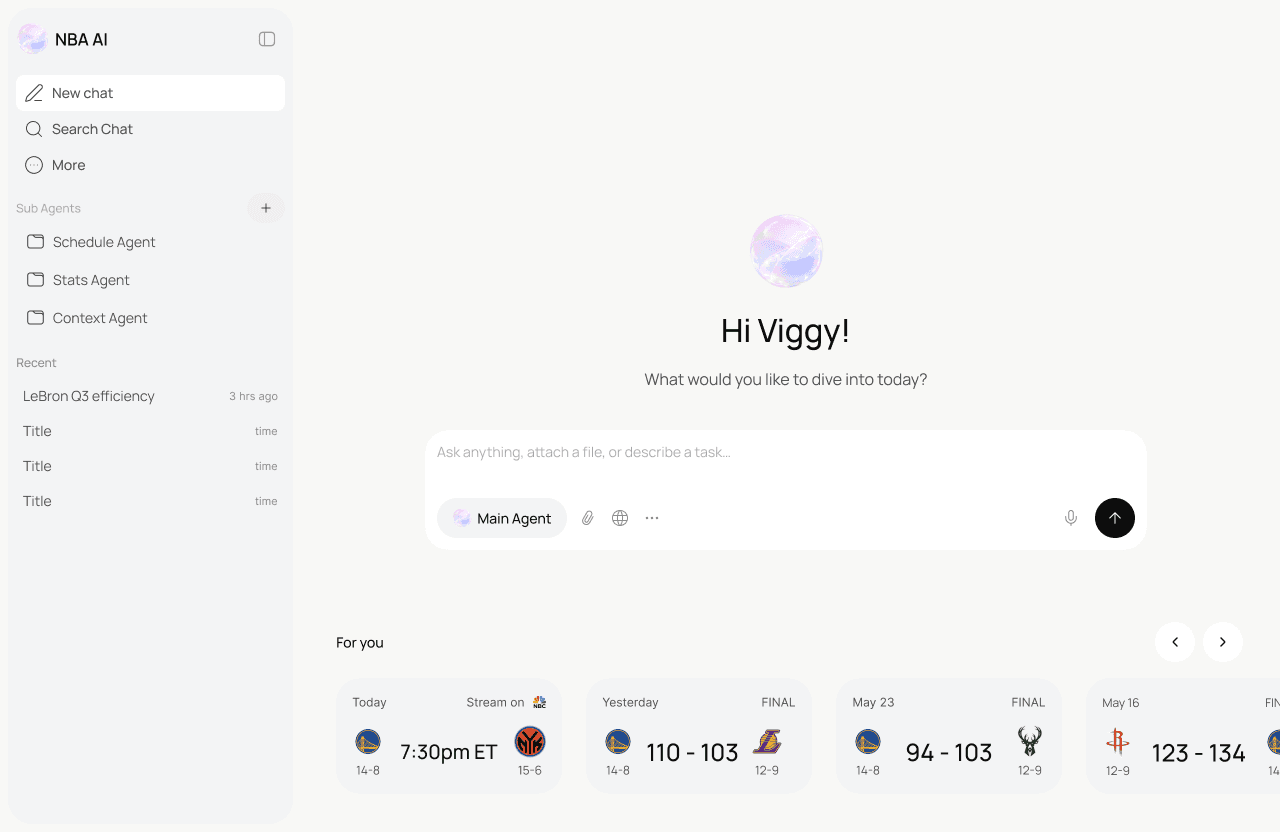
Option A — early exploration

Option B — shipped direction
Design Decision
Inside the NBA app or standalone?
Building inside the league app would mean distribution on day one and a League Pass worldview. A fan with Hulu Live and Prime still needs an answer across what they already pay for.
OPTION A
Inside the NBA app
· Distribution on day one
· League Pass worldview only
· Cannot see Hulu, Peacock, or Prime
OPTION B · CHOSEN
Standalone companion
· Connects to five streaming services
· Can answer across subscriptions
· Has to earn every open from zero
Solution · Onboarding
Set up teams, streaming, and alerts
Pick the teams you follow, connect the streaming services you already pay for, and choose which alerts you want. Each step asks only for what it needs so the companion is ready by tip-off.
Set up once. Use it all night.
Solution · Before the game
See tonight's slate and ask before tip-off
See what's on tonight, where each game airs, and what's in your plan. Ask about injuries or lineups, set an alert for tip-off, or skip and keep browsing.
Set alert and No thanks are the same size. The agent can offer. The UI should not lean on yes.
Solution · During the game
Check the live game without leaving the couch
Keep the phone beside the broadcast. Check the live score and box score, ask what changed in the last few minutes, and get a short read when you want one with sources you can open.
While the agent loads, it lists sources instead of showing a spinner.
Solution · After the game
Review the night and ask follow-ups
Open a post-game breakdown, jump to the parts you care about — shooting, fouls, top performers — and ask follow-ups in the same thread.
Review the night without leaving chat.
Agent Architecture
Three specialists + one orchestrator
Three, not one, because three questions carry three different kinds of truth. Schedule and blackout status are a lookup always confident. Injury status is reported by humans and changes by the hour , always time-stamped. Live stats are a stream, ~30 seconds behind the broadcast by design.
Three, not five, because that's every confidence domain the product touches right now. A fourth agent would mean a fourth kind of data and the two real candidates, fantasy and betting, were cut in week one.

Human Control
Stopping the agent, changing the question, reading the labels
A companion that talks through a game night needs exits. The fan can stop a response mid-stream, ask something different, and see what the system is checking while it works.
Interrupt and redirect
Visible reasoning

Who is speaking

Always visible
Control in settings
Depth, data, and alerts stay in the fan's hands
Beyond the chat thread, settings make the same principles durable: how deep answers go, what data the agent may use, and which alerts fire.

How much context

What powers the agent

What reaches the lock screen
Responsible AI
Designed with EU AI Act principles in mind
Hoops AI is a consumer companion prototype, not a claim of high-risk conformity under Regulation (EU) 2024/1689. The Act's risk-based rules still shaped what I put in the UI: transparency when people talk to AI, human oversight, and outputs that can be interpreted.
AI ACT IDEA
IN THE PRODUCT
Transparency when interacting with AI (Art. 50 spirit)
AI disclosure in chat. Agent labels on responses.
Human oversight (Art. 14 spirit)
Stop generation. Ask something else. Response style, data toggles, alert controls.
Interpretable outputs
Named sources. Facts vs analysis containers. Last-checked on probabilistic data.
Limitations disclosed
Confidence follows game state. No silent pick when sources disagree.
Principles alignment — not a compliance claim.
Intended Impact
From standalone companion to embedded agent
Design intentions for the sprint prototype , not measured outcomes.
V1 was a phone app a fan opens on game night. One place for before, during, and after the game. The complicated stuff (sources, updates, routing) stays behind the scenes.
Key Learnings
Human control is part of the product. Stop, redirect, sources, settings, and equal decline states are how trust shows up in the UI.
Scope cuts keep agent design precise. Cutting fantasy and betting kept the roster at three confidence domains instead of inventing a fourth agent.
Surface follows behavior. A polished desktop dashboard still loses if fans already hold a phone beside the TV.
More projects